Blog

Uncategorized

Update 2 Gotenna Emergency Beacon 5.0 update issues.

TLDR Gotenna Update 5.0 7/13/2018 issues review 2 after 12 hours:

  1. Update not working with some devices;
  2. Firmware not updating on some devices;
  3. Gotenna mesh device is freaking out after [irreversible?] firmware update;
  4. Gotenna emergency device getting STUCK in Emergency Beacon mode spamming emergency messages and clogging channels?
  5. While connection seems better, repeated lost connection requiring hard reboot of remote gotenna relay device after 3 hours;
  6. Emergency Beacon mode failure;
  7. ?6 hop limit imposed on Emergency SOS and beacon shouts?
  8. ?is Gotenna plus sms / text relay being used for Emergency SOS beacon?
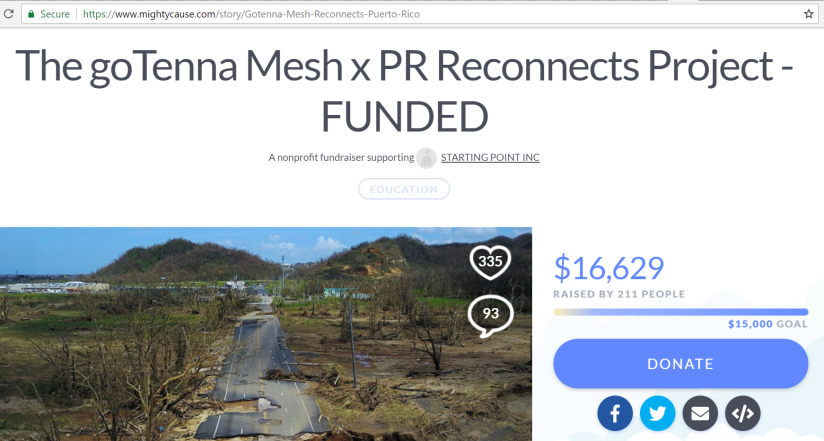
  9. ?Still no update on Puerto Rico… still no 300 devices forming “critical backbone” for emergency communications in hardest hit regions. Even after $900,000 in Fed Gov taxpayer money and $16,629 crowd-source donations and $4,000 directly to Gotenna from Puerto Rico disaster relief?
  10. Emergency Beacon broadcast messages NOT showing in notifications or Emergency chat transcript on sending device. (No log, no confirmation, read receipt…nothing).
  11. Where is Puerto Rico on the downloadable maps?? Not included in US? Not worthy of its own Country listing? #NoLove? #PuertoRico
  12. Where can we send logcat? or debug info?gotenna fix #imeshyou #gotenna #txtenna Gotenna @Gotenna https://medium.com/@frankbryan/tldr-gotenna-mesh-emergency-communications-review-2-of-update-5-0-app-and-firmware-80a04375e871
Uncategorized

*UPDATE 7/13/2018* Decentralized Emergency Gotenna Mesh Communications backup network in Puerto Rico

It’s now been almost a year since hurricanes Irma, Jose, Maria and countless mudslides tore into the heart of Puerto Rico, Florida, the USVI, and the Caribbean.  Much progress has been made. Power, communications, and water have been restored to much of the islands.  However, this progress is tenuous as we saw with even tropical storm Beryl. Light rains and wind can knock out 41,000 Puerto Rican families from the power and communications grid in the blink of an eye.  Even a few inches of rain can create catastrophic mudslides and flooding that close mountain passes and render towers inaccessible to receive diesel.  What will another Maria do?

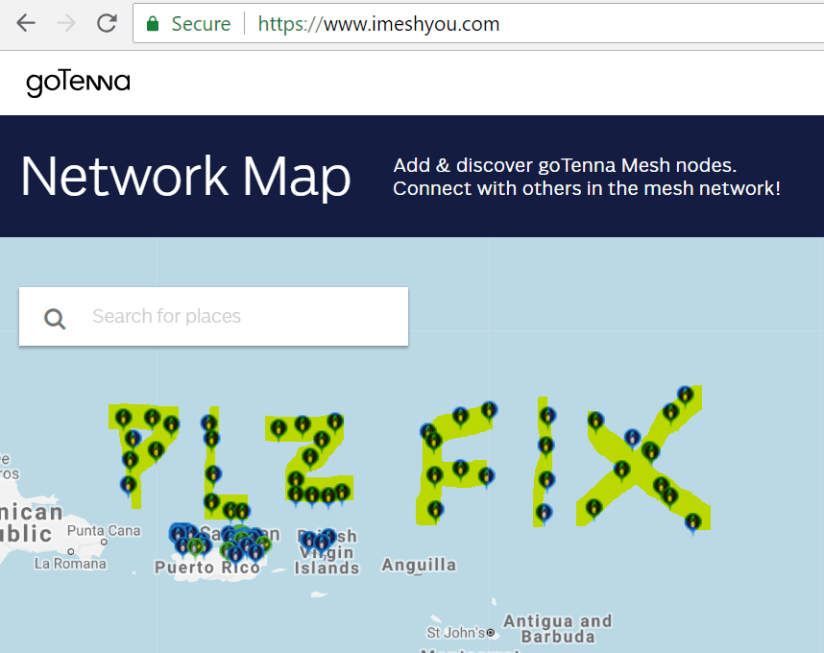
Unfortunately, there has been NO PROGRESS whatsoever with Gotenna in the last year.  Out of the 300 emergency communications backup relays that were to be installed in Puerto Rico to help with relief efforts and serve through the 2018 hurricane season- none have been delivered, installed, or published since the original 16.  There are still no publicly available emergency relays other than the ones published on http://imeshyou.com for municipal San Juan and Barranquitas since November – still only 16 of the 300 have been published. Only 84 have been confirmed to have even shipped to Puerto Rico following the successful crowdsourced fundraiser on Razoo by Gotenna partnered with PR-Reconnects.  But we have no idea where they are – and first responders and survivors are unable to leverage them.  Worse, NONE of the Federal Emergency Management FEMA, Homeland Security DHS, Customs and Border Patrol CBP, or Coast Guard USCG nodes that our $900,000 in taxpayer funding payed for have made it to Puerto Rico or been published for first responder, NGO, or community use. None.  Even though Gotenna has taken literally millions from the U.S. Government, not a single emergency management communications relay or crowd-funded relay or donated node from Gotenna has made it’s way to the map to enable use by disaster victims or survivors – in stark contrast with Fema’s ICS/NIMS guidelines (“it is critical to know where… resources are located”).  And rather than answer any questions, Gotenna cries fake news and steadfastly refuses to answer.

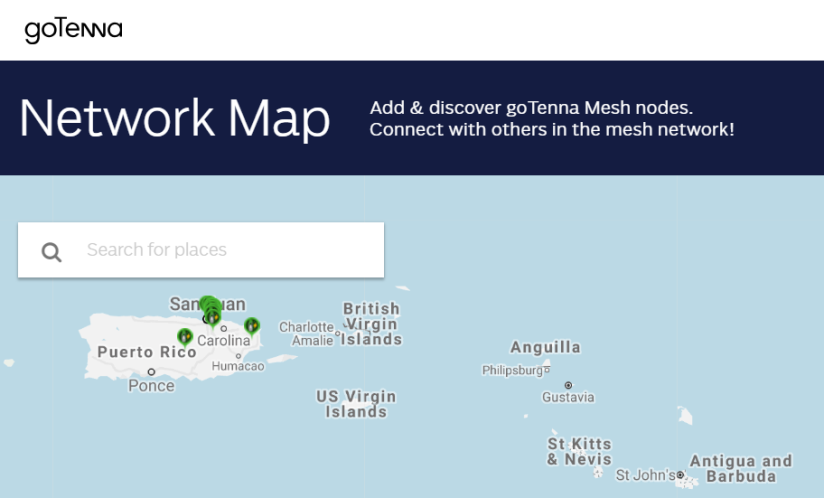
gotenna map

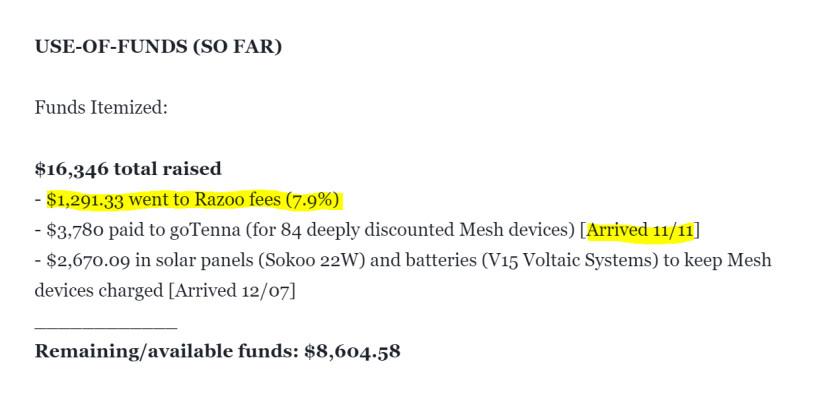
Where’s the $900,000 in recent Federal Government spending on Gotenna? Where’s the $16,600 crowd-funding? Where’s the $4000 Gotenna took from the fundraiser for Puerto Rico disaster relief? Where are the 216 Gotenna meant to form a “critical backbone” for Puerto Rico relief, rebuild, and recovery- that never made it?  How many of the 84 have been installed with solar battery backup and iphone with sms or satellite backhaul – as promised?  Did Razoo indeed take 10% off the top from donations to aid Puerto Rico disaster recovery as alleged?

funded.PNG


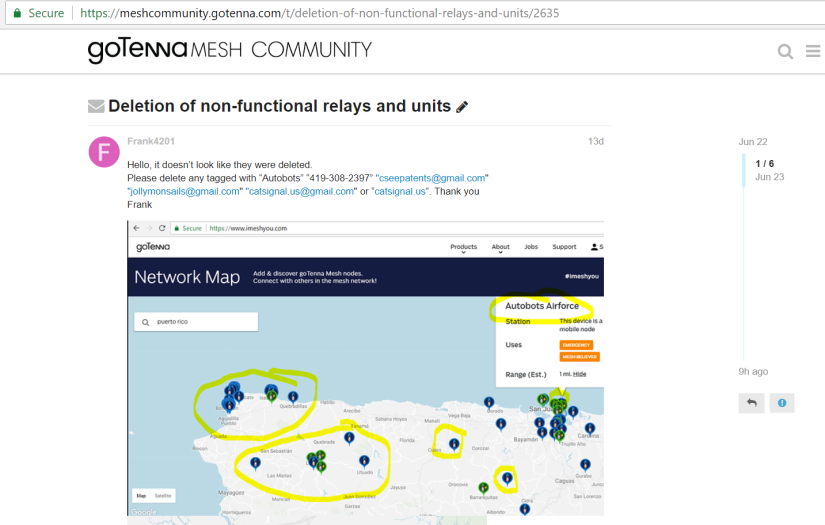
I guess we have to be content not knowing, because one thing is for damn sure: after a year of questions in every form possible, Gotenna is NOT answering.  Instead, Gotenna has deleted/censored any posts asking questions, ignored emails to customer service, even going so far as to banhammer, for literally a thousand years, any account raising a legitimate question about Puerto Rico or an update to the map of emergency relays.


not deleted

thousand

suspended

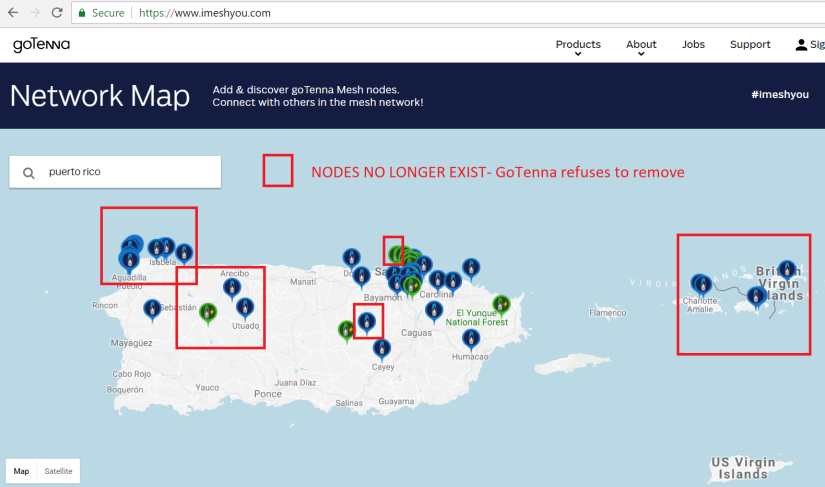
Now for the good news: Gotenna HAS ultimately responded by updating their map of Puerto Rico emergency gotenna communication relays- NOT to add any of the 216 nodes, but to *remove* about 25 Gotenna relays known to no longer be on the island belonging to DHS Disaster Medical Assistance Team DMAT, Coast Guard, US Airforce, Piratas, Valor Response Team and others. They still have not removed the All Hands Gotenna units from USVI. But they, at least, have made an effort, albeit minimal and quite late.  It’s somewhat remarkable that they refused to do this for months and only completed the task LITERALLY as tropical storm Beryl dissipated AFTER hitting Puerto Rico. #SafetyThird 

gotenna deprecated

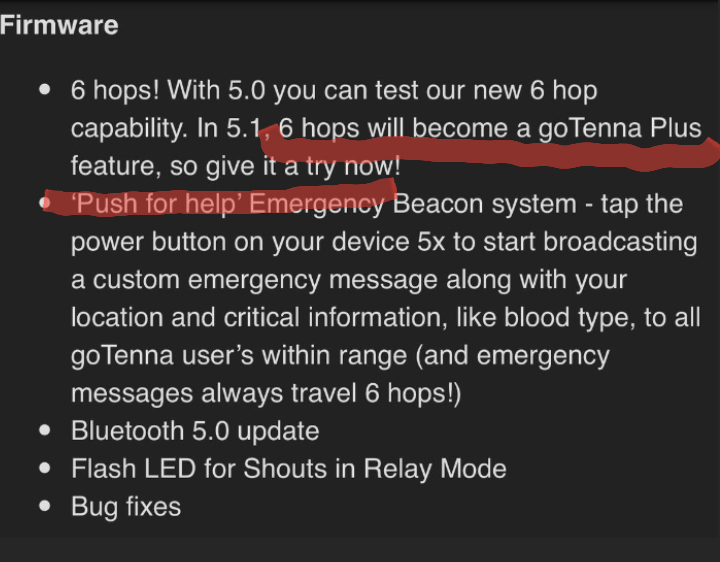
Gotenna has finally issued the updated 5.0 (promised for January).  Initial impressions are that they have done a pretty damn good job – better late and correct than early and fubared. The bluetooth connection stability issues that plagued version 4.x seem to have been remedied so far.  5.0 seems to maintain and auto-restore bluetooth connection much more reliably – and messages seem to cache to a gotenna for delivery once connection is reestablished with the phone.  They’ve finally updated to 6 hops communication relay (up from 3).  They’ve provided a sweet new SOS emergency beacon feature with customizable emergency message which can even be triggered by the gotenna device without the phone by rapidly tapping the gotenna power button five times. *(It should be made clear that GPS position may be stale in headless mode and this doesn’t seem to work on all phones)*.


However, it’s not clear if the 6 hop limitation will apply to emergency SOS shout messages or whether the emergency SOS shouts will employ the SMS relay function.

Built on Gotenna SDK apps are starting to bear fruit.  Gliderlink (a free 3rd party app) seems to be providing great blue-team tracking (up to 62 miles away!!!!) on vanilla Gotenna mesh devices. Samourai Wallet seems to be getting ready to release TxTenna – an app to allow offline sharing of bitcoin.  Mesh Toolkit (only on iOS :((( provides some amazing scripting, automation, twitter and webserver backhaul options to allow for completing hops across the internet, IFTTT programmability, SQL queries, amazing geek shxt. WISH THIS WERE AVAILABLE FOR ANDROID!!! For example, you can have your home relay gotenna automatically respond to queries with updated gotenna battery level, iOs device battery level, backhaul connection status, iWatch augmented reality AR integration … it’s truly amazing.

The deadline for SDK app competition submissions has been pushed back- 30 days away: August 13 for a chance to win a fully-paid first class trip to NYC and up to $1500 in cash and another thousand or so in loot. Some other prizes for second and third place too. Anyone can enter – even if you don’t have a gotenna yet.

1500

What taxpayers and Government oversight reform committees, reporters, watchdog groups (HELLO EFF) and IGs should be asking is… how much of the upwards of $900,000 in taxpayer funds were committed to the Gotenna PRO model which is wholly incompatible with the first responder, community, and NGO friendly Gotenna MESH device?  What Razoo, as the fundraiser, and Gotenna, as a “partner” in the Puerto Rico fiasco, should be asking is: “where tf are the 84 Gotenna emergency relay devices?”

In broader brush, with societal level implications, how do we put the United States Coast Guard LifeFlight or 911 or FEMA, for example, in touch with communities, with abuelas in the mountains that do not have fancy thousand dollar “PRO” gadgets when the towers invariably fall, the lines dip in puddles, poles shattered like toothpicks, no phone, no internet, no wifi…. People that most need help will likely only have an old version of an android Obama phone – with older versions of android. THEY need to be able to call for help. They need reliable information during and after a storm. Partnership needs to be made with NextRadio to use the FM / NOAA emergency broadcast messages.

Thinking constructively, for the devs, if Gotenna Mesh (900Mhz) is indeed wholly incompatible with Gotenna PRO model (140, 440Mhz) sdr that gov first response and leos will be using… can leo and first responder devices easily and reliably bridge the gap by running both Gotenna PRO and commercial public SOS Gotenna mesh apps and reliably supporting both simultaneously over bluetooth?  It strikes me as ironic that the PRO model CANNOT receive Emergency SOS shouts in cleartext over public airwaves, with full licensure and emergency exemption from FCC redtape. There’s literally no way to let First Responders .gov communicate with the public emergency SOS Gotenna mesh? #Irony

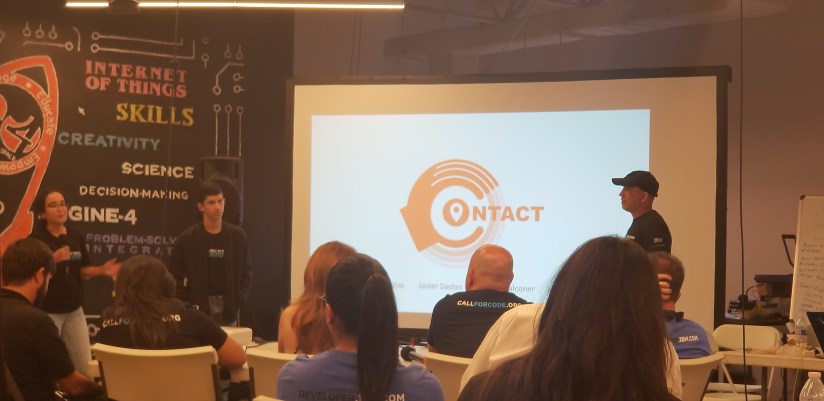
There has been a very very cool development in Puerto Rico. Just last week, a consortium of some serious players, scores of innovative entrepreneurs, students, ngos, startups, and non profits all came together to do a public collaboration, with the University providing free space, computers, internet, cafe? for what the makers call a hackathon. Several REALLY cool ideas have come from this with volunteers writing code and sharing ideas, collaborating toward reliable and usable emergency backup communications on the island. #CallForCode #MeshingWithData

Through all of this, some minor concerns remain; accordingly, these are the 20 best questions, that while likely never answered, may be worth pondering going forward:

  1. Will Gotenna ever donate the remaining 216 units to Puerto Rico?
  2. Will PR Reconnects or Gotenna ever build an actual critical backbone – as promised?
  3. How many of the 84 have been donated or placed with communities or First Responders?
  4. How many of the 84 have been deployed with solar, battery, iphone, satphone, or sms backhaul?
  5. Will the SMS / SatPhone / Twitter medical relay backhaul ever be functional?
  6. Will they ever publish the locations of the donated or the taxpayer funded public comms relays?
  7. Will they ever provide for pruning stale emergency relay locations from the map at imeshyou.com to remove some of the no-longer functional gotenna emergency relays?
  8. They have indicated that a hardware change will be necessary to allow auto-power restore. Is this coming before Hurricane Season really picks up? Will Mesh v2 include the GPS chip for true headless SOS and more intelligent mesh routing, especially for MOAN relay nodes?
  9. They have indicated that the 6 hop functionality will be crippled with the next version and require a $9 subscription. Is this 6 hop limit artificially imposed on Emergency SOS broadcasts? Or will it remain unlimited?
  10. Some phones are being reported to not work with the Emergency Beacon functionality. Will this be corrected and when?
  11. Gotenna, cognizant of their very limited range should partner with Next Radio App or another FM radio app that could allow some form of the one-way emergency transmissions.
  12. FEMA, DHS, and USCG should coordinate more with Gotenna as it is now a defacto emergency backup communications critical national infrastructure operating with public funding on public airwaves and employable to save many lives.
  13. Will Gotenna, as a publicly funded communications common carrier using public communications frequencies, stand up and commit to defending the spirit, if not the letter, of the First Amendment?
  14. Will Gotenna commit to working with other disaster communications options like Beartooth (another publicly funded mesh communications device using the exact same public ISM 902-927Mhz airwaves) or Sonnet labs or Globalstar Spot X or Garmin Inreach Sat phone devices or BridgeFy, Briar, Firechat?
  15. Given that Gotenna cannot effectively moderate or curate their imeshyou.com map to maintain emergency node locations, will they move to a community moderated map? an open (opt-in) dynamic map? Or an open-source map like Open Street Maps, Open Signal, or Aftermath mapping?
  16. At what point does a common carrier that we entrust with our data, taking millions of our taxpayer and consumer dollars, freely using public resource airwaves, start having an obligation to live up to certain common decencies?
  17. Why would you build the Government Gotenna PRO to be wholly incompatible with the Gotenna MESH (the one used by everyone for Emergency SOS shouts?) How does a survivor reach one of these first responders? What best practices do you suggest? Any ideas?
  18. Does a government contractor, paid with our taxpayer money, in compliance with statutes, necessarily have to provide some level of public open source access or  audit of the code created with gov funds? foia?
  19. If a company is going to market to first responders for emergency, disaster “critical” communications, should that company perhaps have a help-desk open after-hours? Perhaps during hurricane season or when there’s 1, let alone 2, active hurricanes?
  20. Why does it take several months to get a Gotenna curated map updated to remove emergency communication relays which are KNOWN by Gotenna to NOT EVEN EXIST anymore? Why months? What was the communication breakdown and how can we avoid that again? Are you following ICS/NIMS guidelines? Are there proper channels in place, as a corporation, for Gotenna to communicate directly with FEMA, DHS, and local first responders & municipal leos? #SafetyThird

https://medium.com/@frankbryan/update-7-13-emergency-decentralized-critical-mesh-communications-in-puerto-rico-usvi-and-199897f2ac7f

TLDR; not good but some hope and recent improvements in almost all areas.

If Gotenna REALLY wants to stand up and lead, they could start with donating the few hundred (or even a few dozen) they promised. With millions from the feds, 20–40,000 device sales, a grant to supply another 20,000 to NYC alone,Gotenna has the means but chooses not to do the right thing. IMHO. Though they are right… they are not in the helping people game; it’s likely not directly profitable immediately; they were only paid $4000 from the fundraiser. But this investment in Puerto Rico would pay off by jumpstarting Puerto Rican businesses founded by Boricua computer sciences, IT, electrical engineering students. The dividends would pay back a thousandfold, by exploding the iOS, Android, and PC/Mac app stores with customized emergency and first responder, hiking, sailing, kiteboarding apps tailored by geniuses in their own self-interest in every imaginable area which will in-turn drive new device sales, with a positive chain reaction of people seeing the network growing and buying to join. Gotenna is uniquely situated to address this and, it would be folly to miss this opportunity to help.


Uncategorized

Gotenna Emergency Mesh Network in PR

GoTenna took $4000 from a fundraiser that was to supply Puerto Rico with “hundreds” (“up to 300”) emergency, low-power communication devices for the “central mountainous region” to help “hundreds of thousands” of those hardest hit in at least “15 municipalities” without communications.  These donated gotenna mesh devices would have still allowed Puerto Ricans to communicate with their community and with first responders even when the towers fell or diesel wasn’t available.

The fundraiser to reconnect Puerto Rico was FULLY funded in November 2017.  However, as we approach April 2018, GoTenna and Daniela Perdomo, CEO, have simply washed their hands of their commitment -walking away with priceless promotion, accrued goodwill from the community, social media bump, $4000 in donated funds which were meant to help Puerto Rico and another million dollars in funds from FEMA / Homeland Security.  This isn’t the first time they’ve done this either.  They claimed to have helped USVI as well, however, ZERO permanently powered relays are shown on their imeshyou.com map.

gotenna social media
No less than five links to Gotenna’s social media pages adorn the fundraiser page

In spite of their fiduciary duty over the fundraiser, as the organizer, and that owed to the beneficiaries and donors, they refuse to correct the record and allow falsehoods such as the crowdfunding website took 10% of the funds – which is bullshit. Razoo waived fees for hurricane relief fundraisers benefiting Puerto Rico – and have confirmed as much to me privately.  This allows Gotenna to pretend that less than $10,000 of donated funds lie fallow since November unused.  When exactly the opposite is true.

razoo fees

Instead of the promised hundreds of gotenna devices to provide communications to the central mountainous region – only 16 have been installed. Only 80 have even been shipped to the island – and this ceased in November. Gotenna is supplying 20,000 to New York City for free to businesses… and 20 at a time to affluent ski resorts… but when it comes to their promise to deliver a few hundred to Puerto Rico? Silence. Crickets. Will they respond? Correct the record? Or continue to delay and ghost the survivors? FOUR months ago, we could have built out a backup network. Now, with their dissembling, obfuscation, and lack of transparency, we barely have 2 months left before the next storms start arriving.  Make no mistake, when the towers fall again, the blood will be on their hands.

https://www.razoo.com/story/Gotenna-Mesh-Reconnects-Puerto-Rico

My suggestion: PR Reconnects and Javier Malave’ simply do not have the bandwidth to deploy the hundreds of emergency devices promised.  This doesn’t mean that GoTenna should just walk away though.  A fiduciary duty, a moral and ethical duty, and a binding contract with the people of Puerto Rico has been established with ample consideration flowing to GoTenna.  PR Reconnects isn’t the beneficiary, the people of Puerto Rico are.

The right thing to do is, nonetheless, send the remaining 216 Gotenna units to Puerto Rico. If Javier and PR Reconnects don’t have the bandwidth, cut out the middle-man.  Send the units directly to the geeks, the Computer Science departments of the Universities such as University of Puerto Rico Aguadilla, The Interamerican University, the University of Arecibo; University of Mayaguez; Universidad del Sagrado Corazon; send them to municipal leaders; send them to hospitals like Buen Samaritano.  The benefit of -this is that it’s truly a decentralized approach which grows the network organically with no single point of failure like PR Reconnects or Javier.  Additionally, by sending to the students directly you empower them to develop disaster communication applications using the GoTenna SDK which have never been envisioned.  Innovation will flourish, built-on-Gotenna(TM) apps will fill the play store.  This allows people (without relying on any middlemen) to opt-in and voluntarily place their nodes on the imeshyou.com map which has a positive feedback effect and encourages more people to buy their own gotennas to join this network they see growing in front of their eyes – in their own self-interest to gain access to this network; especially knowing that there are at least 15 Gotenna-Satellite gateway devices out there and every single Gotenna device can act as a relay between the internet and Gotenna to deliver SMS messages to those without Gotenna devices.  If GoTenna and Daniela Perdomo have a heart (or at least half a brain) they will live up to their promise and start shipping a few dozen gotenna devices to the students, the first responders, and the leaders of Puerto Rico.  When the storms on the horizon hit, GoTenna will be responsible for either the biggest failure to come, or the greatest success.  Here’s to hoping they do the right thing.

Uncategorized

Publicly funded GoTenna mesh network concerns in Puerto Rico for 2018

first and crucial
First and crucial steps by deploying hundreds of GoTenna Mesh

GoTenna and PR Reconnects have finally provided an update after threatened with a lawsuit. As it turns out, our fears were correct and well-founded.  Rather than providing, deploying, and making available the 300 emergency mesh communication devices to those most in need in Puerto Rico, only 16 have been installed. Instead of all municipalities (or even the fifteen hardest hit), only one municipality outside San Juan has been installed.  However, perusal of their social media histories indicates that these 16 were *already* installed, prior to the fundraiser exceeding their goal.

Daniela
Hundreds more units to set up GoTenna Mesh clusters in ALL municipalities

So, what have they done in the past four months with the publicly donated $17,000? Effectively nothing. None of the funds have been employed, no additional Gotenna emergency mesh units have been installed. In fact, instead of the hundreds promised, GoTenna has only delivered 84.  In contrast, GoTenna have tirelessly devoted their resources and engineers to install and deploy mesh networks in affluent ski resorts … but when it comes to their commitment to Puerto Rico, and those hardest hit (with a GDP less than half of Mississippi), GoTenna is content to fall far, far short of their promises and wash their hands, victim-blaming their partners.  GoTenna apparently lacks the labia or cojones to deliver what was promised to Puerto Rico.  Moreover, shedding light on the hypocrisy, GoTenna has published and made available every single node’s locations on imeshyou.com to enable their use by the public at these ski resorts.  In contrast, they’ve mansplained-away their absence from Puerto Rico as “opt-in” and non “dynamic.”  However, publicly funded mesh units, statically deployed as permanently powered public relays should be published to allow the public to benefit and leverage them.

utah2

utah
GoTenna engineers install and publish locations of nodes at ski resorts

After Hurricanes Maria, Jose, and Irma, and countless mudslides, flooding, and loss of lives (some areas STILL without power), the public stood up, and courageously made choices as to where their funds would best help. The public took GoTenna at its word- that providing an emergency mesh communications backbone for first-responders, relief-workers, communities, and ngos offering aid was, in Gotenna’s words “crucial” to saving lives.  The people overwhelmingly donated and exceeded the goals of the fundraiser by several thousand dollars. Now, the ball lies in GoTenna’s court, yet only 16 of the promised hundreds are installed. Only 84 have been shipped. By their own admission, these donated funds (that could have been employed) lie fallow, unused.

Help was offered months ago; since October – volunteers, first-responders, relief-workers, municipality leaders, and student interns from local universities were lined up and ready to help on the premise that an actual resilient, backup emergency communications backbone was going to be built.  Gotenna’s laudable promises sucked up all the goodwill of the community and forestalled others from building this backbone, as we all acted in reliance on the promises of Gotenna and PR Reconnects.  Now, six months after the storm, with less than three months to go before the next battery of monster storms are unleashed on the island… where are we?

To exacerbate issues, GoTenna has taken over a million dollars from Homeland Security and DoD (publicly) not to mention untold amounts from In-Q-Tel (IQT) – and the FCC has authorized another billion dollars to help reconstruct communications systems on the island.  But, in direct opposition to the National Incident Management System (NIMS) guildelines, not a single Gotenna device location has been published for Puerto Rico on Imeshyou.com, or on first-responder geolocation tools like Aftermath Rescue or ANY publicly available mapping providers.  To those with even a rudimentary understanding of mesh networking, much like real estate- location matters. If first-responders, communities, ngos, and relief-workers do not know where the powered emergency mesh network relays are, it makes it very difficult to call for help, coordinate scarce resources, or avoid duplicative efforts.

where they at
It is critical to know where deployed resources are located

Gotenna needs to live up to their promise and send the remaining emergency mesh units to Puerto Rico. If Homeland Security or Fema have installed hurricane resilient permanent relays in Puerto Rico, they need to publish the locations as mandated by NIMS/ICS best practices to allow the communities to leverage these communications options come June and Hurricane Season 2018.  If they have not yet installed these permanent relays, then they need to start. The clock is ticking.

If GoTenna, Homeland Security, Fema, and PR Reconnects think that they will be able to casually ship in these units and deploy them AFTER the next hurricane, as someone who has waited in line at Fed Ex in the hot sun for hours, I can tell you, this is not a good plan.  I agree with Javier J Malave Bonet’s idea to save some in reserve, however, we need a strong, hurricane-resilient, permanently installed and solar-powered backbone already in-place before the next disaster strikes.  At only $45 for a Gotenna Node, another $50 for a waterproof solar panel, battery, and hurricane box, this is a steal relative to the literally BILLIONS of taxpayer funds that the FCC wants to invest in traditional lines, cell towers, and generators – that inevitably fall (or run out of diesel).  We need to rethink our approaches and outsmart the storms if we are to survive.


Mesh, Uncategorized

GoTenna concerns in Puerto Rico, USVI & Caribbean

It has now been almost five months since hurricanes Irma, Maria, and Jose and numerous mudslides hit Puerto Rico and the Caribbean leaving a path of absolute destruction.  Over 93% of cellular communications; over 90% of power and home/business wifi were taken out.  Basically, large portions of the Caribbean were taken back to the stone age.  At the same time the hurricanes started hitting, Gotenna released the very first (and still only) consumer-ready off the shelf long range mesh communication device that works in an adhoc manner without requiring infrastructure (no home wifi, no satphone, no cell towers needed) it just works.  Gotenna is entirely self-sufficient and offers a 3-4 mile range (under ideal circumstances up to 57 mile range).  They are reasonably priced at only about $50 a piece.

So, the idea was to pepper the island with a backbone of these gotenna devices to assist in disaster relief, command, and coordination.  I acquired about 30 and hopped on a plane to join Javier J. Malave Bonet in San Juan to help him and while he established a network in San Juan, I went out west to Aguadilla and established a network connecting first responders including DHS (Dept. Homeland Security) DMAT and US Army MASH units at Buen Samaritano hospital to US Coast Guard helo lifeflights, Customs and Border Patrol, and US Airforce med evac and logistics at the Rafael Hernandez airport along with several groups of volunteers and municipality-leaders.  Javier had access to 41 units.  We quickly realized that many, many more would be needed.


partnered2

Javier Malave and Gotenna partnered to create an indiegogo-type public fundraiser to raise about $20,000 in order to buy 300 more Gotenna mesh units to distribute them to create a backbone across the island to enable crucial communications for first responders aiding in the relief effort.  The units were to be delivered in installments.  The money was raised fairly quickly however, after the first shipment of 80 arrived, Javier, GoTenna, and PR Reconnects went dark – no updates, no publication of node deployments, unresponsive to private messages.

asdfwww

Separately, in parallel, DHS and DOD spent about $800,000 in taxpayer funds on Gotenna units.  However, to this day, 5 months later, only 6 (and only in San Juan) of the nodes are published on imeshyou.com (or anywhere) to allow communities, NGOs, and first responders to leverage this infrastructure.  STILL ONLY 6 of the 300 units donated to Javier and PR Reconnects – ONLY 6 have been deployed and their locations published on the map and NONE of the DHS or DOD units seem to have been deployed.  Map below actually shows devices installed BEFORE the fundraiser (and in several cases nodes established by other, 3rd parties).

where are

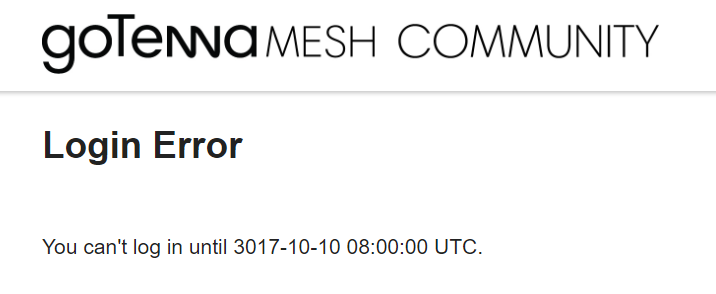
For months on their forum at imeshyou.com, by email, phone, by twitter at catsignal.us, on facebook at circleofcompassion.us, and instagram at instagram.com/jollymonsails , I’ve tried to elicit a status update in bona fide good faith- earnestly hoping to encourage Gotenna to publish the locations of the public relays but with no luck.  Instead, PR Reconnects, Javier, Gotenna, and their partners have deleted my posts, suspended my account for 999 years (until 3017), deleted my account at Gotenna-controlled imeshyou.com and blocked my access on every social media platform available.  EVEN offered to pay me a thousand dollars! Rather than merely providing an update.

wtf

deleted

My concern is that Hurricane Season 2018 is rapidly approaching (3 months out) and we still don’t have ANY idea where the 300 publicly donated gotenna units are or if DHS / FEMA / DOD have deployed even 1 to Puerto Rico or USVI.  To exacerbate issues, Gotenna decided to save a few pennies and omit the Skytraq Venus GPS chip that was advertised and discussed such as on the Ask an Engineer program with Lady Ada of AdaFruit featuring Daniela Perdomo and members of the Gotenna team.

As a result there’s no GPS functionality at all.  This means that the Gotenna unit cannot act as a headless SOS device by itself – but instead force survivors to have a working phone with a pre-installed Gotenna application.  AND there’s no beacon or advertise function of the permanently installed relays – and no restoration after power outage.  So, if PR Reconnects or Gotenna continue to delay and ultimately decide not to make this information available to the public, there is literally NO way for first responders, NGOS, or communities to leverage the taxpayer or the publicly donated infrastructure.  Moreover, since no one knows where they are and there’s no way to determine whether they are operating nominally – or not, there’s no way that anyone can maintain, upgrade firmware, recharge batteries, swap out defective units, batteries, or solar panels.

And to put a cherry on top of this shit-sundae, GoTenna has now pivoted their attention to a new GoTenna Pro model which operates on WHOLLY dissimilar frequencies and are completely incompatible with this critical communications backbone that we built. What this means is that, for example: a grandmother or a church in the mountains of Utuado, Lares, or Morovis (the first places to lose service and the last to have it restored) who sends out an emergency broadcast via the Gotenna network cannot be sure that the message will get out due to the lack of transparency and accountability of the donated build-out or the taxpayer buildout. Even *IF* this crucial backbone does work in relaying the message, the military and government first responders will be wholly deaf to her pleas (as they can’t even listen to the 902-927MHz frequency range of the Gotenna Mesh devices) as they are stuck in the 100 and 400MHz range.

gotenna pro

Ironically, this then leaves ONLY the volunteer first responders, the same people that selflessly run in when things go wrong to receive requests for help and respond.  However, with Gotenna, PR-Reconnects, and Javier Malave’s lack of transparency and obfuscation, these are the VERY people who have *NO IDEA* where these heavily-proximity based devices are -or if they are even able to receive relayed messages.

The Fema-based CERT (Community Emergency Response Teams) program promotes interoperability of communications devices, accountability: knowing where and updating the locations of emergency resources such as the gotenna devices; AND “prior to an incident” practicing to ensure the interoperability, to make sure they work as intended to integrate these volunteers and NGOs into the disaster recovery picture… however, NONE of these critical ICS/NIMS guidelines are being followed.

sharing info

where they at

I am very concerned that if Gotenna and PR Reconnects don’t adopt a sense of urgency, and start following accountability and transparency best-practices, many people, many Americans will die.  Things aren’t better in Puerto Rico, USVI, or the Caribbean. *TEMPORARY* solutions have been hastily thrown together.  The power and communication lines were strung together in expedited manner; families are living in tents; blue tarps cover roofs, or mere ropes tie down tin roofs.

The first thing that needs to happen is that GoTenna, PR Reconnects, and Javier J. Malave Bonet should simply publish approximate locations of these 341 deployed emergency relays.  Secondly, Gotenna should act with all due haste to issue an updated firmware that provides power-restoration after outage, beacon and advertise functions so that this network can be tested, supplemented, and troubleshot BEFORE the next disaster. Thirdly, if possible, the software defined radio (SDR) in the Gotenna-Pro should be updated to allow for even minimal operation (such as reception alone) in the 900MHz consumer ISM frequency band to at least receive calls for help from nearby civilians and responders.