Uncategorized

Publicly funded GoTenna mesh network concerns in Puerto Rico for 2018

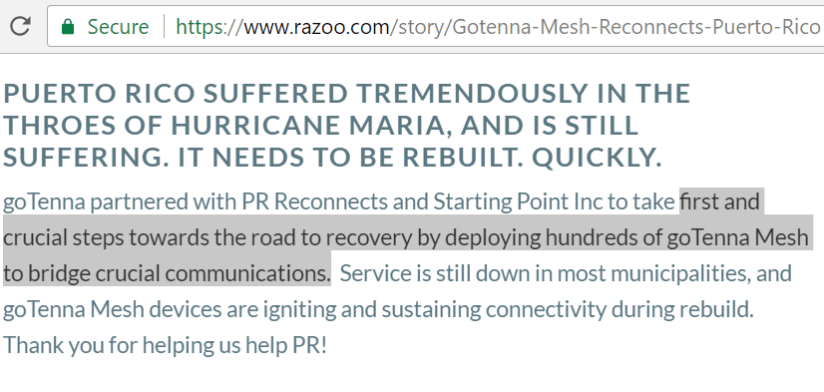
first and crucial
First and crucial steps by deploying hundreds of GoTenna Mesh

GoTenna and PR Reconnects have finally provided an update after threatened with a lawsuit. As it turns out, our fears were correct and well-founded.  Rather than providing, deploying, and making available the 300 emergency mesh communication devices to those most in need in Puerto Rico, only 16 have been installed. Instead of all municipalities (or even the fifteen hardest hit), only one municipality outside San Juan has been installed.  However, perusal of their social media histories indicates that these 16 were *already* installed, prior to the fundraiser exceeding their goal.

Daniela
Hundreds more units to set up GoTenna Mesh clusters in ALL municipalities

So, what have they done in the past four months with the publicly donated $17,000? Effectively nothing. None of the funds have been employed, no additional Gotenna emergency mesh units have been installed. In fact, instead of the hundreds promised, GoTenna has only delivered 84.  In contrast, GoTenna have tirelessly devoted their resources and engineers to install and deploy mesh networks in affluent ski resorts … but when it comes to their commitment to Puerto Rico, and those hardest hit (with a GDP less than half of Mississippi), GoTenna is content to fall far, far short of their promises and wash their hands, victim-blaming their partners.  GoTenna apparently lacks the labia or cojones to deliver what was promised to Puerto Rico.  Moreover, shedding light on the hypocrisy, GoTenna has published and made available every single node’s locations on imeshyou.com to enable their use by the public at these ski resorts.  In contrast, they’ve mansplained-away their absence from Puerto Rico as “opt-in” and non “dynamic.”  However, publicly funded mesh units, statically deployed as permanently powered public relays should be published to allow the public to benefit and leverage them.


utah2

utah
GoTenna engineers install and publish locations of nodes at ski resorts

After Hurricanes Maria, Jose, and Irma, and countless mudslides, flooding, and loss of lives (some areas STILL without power), the public stood up, and courageously made choices as to where their funds would best help. The public took GoTenna at its word- that providing an emergency mesh communications backbone for first-responders, relief-workers, communities, and ngos offering aid was, in Gotenna’s words “crucial” to saving lives.  The people overwhelmingly donated and exceeded the goals of the fundraiser by several thousand dollars. Now, the ball lies in GoTenna’s court, yet only 16 of the promised hundreds are installed. Only 84 have been shipped. By their own admission, these donated funds (that could have been employed) lie fallow, unused.

Help was offered months ago; since October – volunteers, first-responders, relief-workers, municipality leaders, and student interns from local universities were lined up and ready to help on the premise that an actual resilient, backup emergency communications backbone was going to be built.  Gotenna’s laudable promises sucked up all the goodwill of the community and forestalled others from building this backbone, as we all acted in reliance on the promises of Gotenna and PR Reconnects.  Now, six months after the storm, with less than three months to go before the next battery of monster storms are unleashed on the island… where are we?

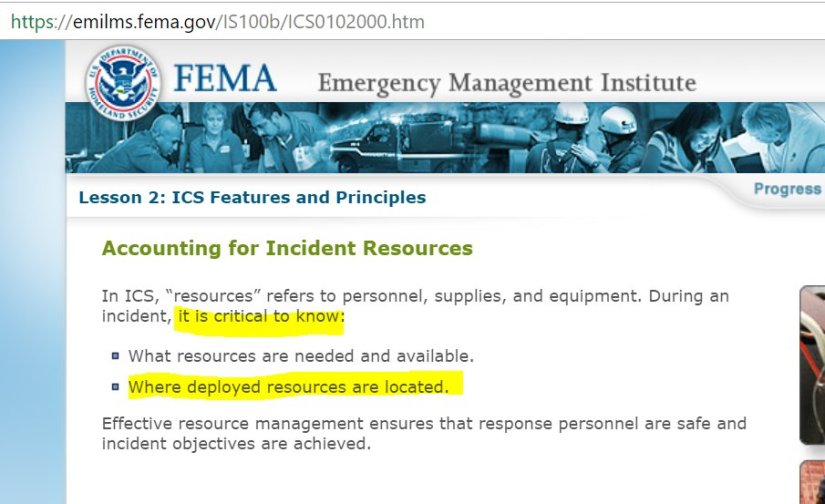
To exacerbate issues, GoTenna has taken over a million dollars from Homeland Security and DoD (publicly) not to mention untold amounts from In-Q-Tel (IQT) – and the FCC has authorized another billion dollars to help reconstruct communications systems on the island.  But, in direct opposition to the National Incident Management System (NIMS) guildelines, not a single Gotenna device location has been published for Puerto Rico on Imeshyou.com, or on first-responder geolocation tools like Aftermath Rescue or ANY publicly available mapping providers.  To those with even a rudimentary understanding of mesh networking, much like real estate- location matters. If first-responders, communities, ngos, and relief-workers do not know where the powered emergency mesh network relays are, it makes it very difficult to call for help, coordinate scarce resources, or avoid duplicative efforts.
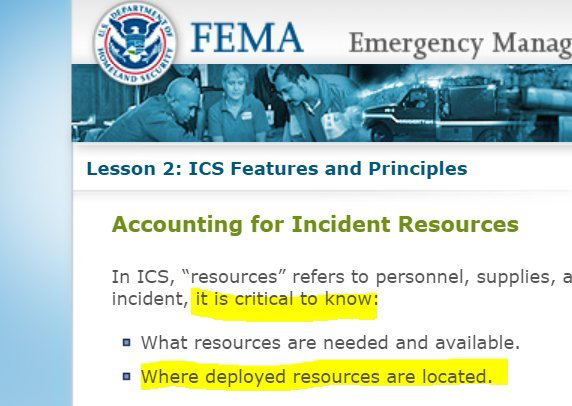
where they at
It is critical to know where deployed resources are located

Gotenna needs to live up to their promise and send the remaining emergency mesh units to Puerto Rico. If Homeland Security or Fema have installed hurricane resilient permanent relays in Puerto Rico, they need to publish the locations as mandated by NIMS/ICS best practices to allow the communities to leverage these communications options come June and Hurricane Season 2018.  If they have not yet installed these permanent relays, then they need to start. The clock is ticking.

If GoTenna, Homeland Security, Fema, and PR Reconnects think that they will be able to casually ship in these units and deploy them AFTER the next hurricane, as someone who has waited in line at Fed Ex in the hot sun for hours, I can tell you, this is not a good plan.  I agree with Javier J Malave Bonet’s idea to save some in reserve, however, we need a strong, hurricane-resilient, permanently installed and solar-powered backbone already in-place before the next disaster strikes.  At only $45 for a Gotenna Node, another $50 for a waterproof solar panel, battery, and hurricane box, this is a steal relative to the literally BILLIONS of taxpayer funds that the FCC wants to invest in traditional lines, cell towers, and generators – that inevitably fall (or run out of diesel).  We need to rethink our approaches and outsmart the storms if we are to survive.


Mesh, Uncategorized

GoTenna concerns in Puerto Rico, USVI & Caribbean

It has now been almost five months since hurricanes Irma, Maria, and Jose and numerous mudslides hit Puerto Rico and the Caribbean leaving a path of absolute destruction.  Over 93% of cellular communications; over 90% of power and home/business wifi were taken out.  Basically, large portions of the Caribbean were taken back to the stone age.  At the same time the hurricanes started hitting, Gotenna released the very first (and still only) consumer-ready off the shelf long range mesh communication device that works in an adhoc manner without requiring infrastructure (no home wifi, no satphone, no cell towers needed) it just works.  Gotenna is entirely self-sufficient and offers a 3-4 mile range (under ideal circumstances up to 57 mile range).  They are reasonably priced at only about $50 a piece.

So, the idea was to pepper the island with a backbone of these gotenna devices to assist in disaster relief, command, and coordination.  I acquired about 30 and hopped on a plane to join Javier J. Malave Bonet in San Juan to help him and while he established a network in San Juan, I went out west to Aguadilla and established a network connecting first responders including DHS (Dept. Homeland Security) DMAT and US Army MASH units at Buen Samaritano hospital to US Coast Guard helo lifeflights, Customs and Border Patrol, and US Airforce med evac and logistics at the Rafael Hernandez airport along with several groups of volunteers and municipality-leaders.  Javier had access to 41 units.  We quickly realized that many, many more would be needed.


partnered2

Javier Malave and Gotenna partnered to create an indiegogo-type public fundraiser to raise about $20,000 in order to buy 300 more Gotenna mesh units to distribute them to create a backbone across the island to enable crucial communications for first responders aiding in the relief effort.  The units were to be delivered in installments.  The money was raised fairly quickly however, after the first shipment of 80 arrived, Javier, GoTenna, and PR Reconnects went dark – no updates, no publication of node deployments, unresponsive to private messages.

asdfwww

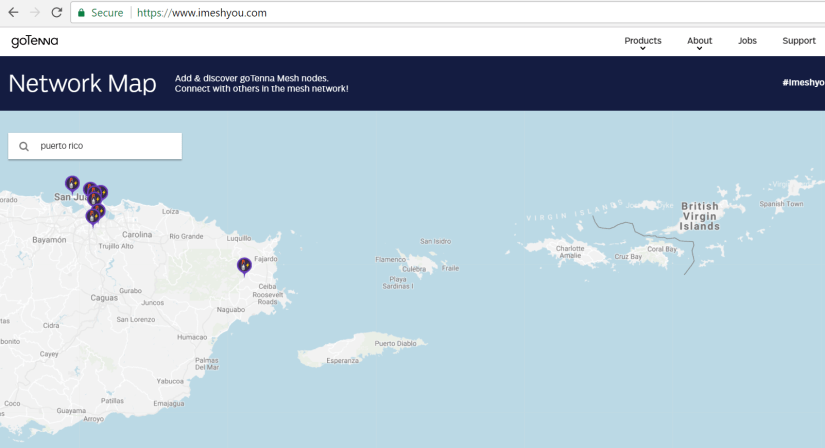
Separately, in parallel, DHS and DOD spent about $800,000 in taxpayer funds on Gotenna units.  However, to this day, 5 months later, only 6 (and only in San Juan) of the nodes are published on imeshyou.com (or anywhere) to allow communities, NGOs, and first responders to leverage this infrastructure.  STILL ONLY 6 of the 300 units donated to Javier and PR Reconnects – ONLY 6 have been deployed and their locations published on the map and NONE of the DHS or DOD units seem to have been deployed.  Map below actually shows devices installed BEFORE the fundraiser (and in several cases nodes established by other, 3rd parties).

where are

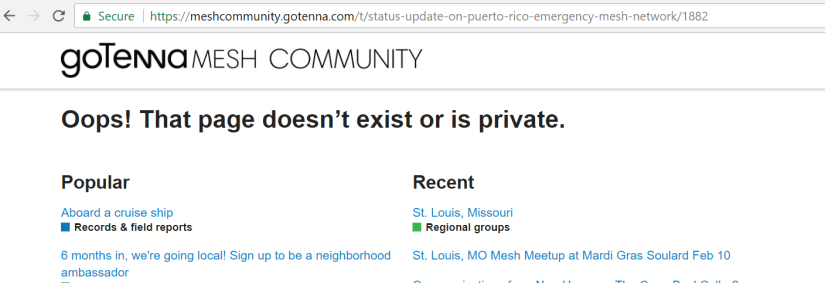
For months on their forum at imeshyou.com, by email, phone, by twitter at catsignal.us, on facebook at circleofcompassion.us, and instagram at instagram.com/jollymonsails , I’ve tried to elicit a status update in bona fide good faith- earnestly hoping to encourage Gotenna to publish the locations of the public relays but with no luck.  Instead, PR Reconnects, Javier, Gotenna, and their partners have deleted my posts, suspended my account for 999 years (until 3017), deleted my account at Gotenna-controlled imeshyou.com and blocked my access on every social media platform available.  EVEN offered to pay me a thousand dollars! Rather than merely providing an update.

wtf

deleted

My concern is that Hurricane Season 2018 is rapidly approaching (3 months out) and we still don’t have ANY idea where the 300 publicly donated gotenna units are or if DHS / FEMA / DOD have deployed even 1 to Puerto Rico or USVI.  To exacerbate issues, Gotenna decided to save a few pennies and omit the Skytraq Venus GPS chip that was advertised and discussed such as on the Ask an Engineer program with Lady Ada of AdaFruit featuring Daniela Perdomo and members of the Gotenna team.

As a result there’s no GPS functionality at all.  This means that the Gotenna unit cannot act as a headless SOS device by itself – but instead force survivors to have a working phone with a pre-installed Gotenna application.  AND there’s no beacon or advertise function of the permanently installed relays – and no restoration after power outage.  So, if PR Reconnects or Gotenna continue to delay and ultimately decide not to make this information available to the public, there is literally NO way for first responders, NGOS, or communities to leverage the taxpayer or the publicly donated infrastructure.  Moreover, since no one knows where they are and there’s no way to determine whether they are operating nominally – or not, there’s no way that anyone can maintain, upgrade firmware, recharge batteries, swap out defective units, batteries, or solar panels.

And to put a cherry on top of this shit-sundae, GoTenna has now pivoted their attention to a new GoTenna Pro model which operates on WHOLLY dissimilar frequencies and are completely incompatible with this critical communications backbone that we built. What this means is that, for example: a grandmother or a church in the mountains of Utuado, Lares, or Morovis (the first places to lose service and the last to have it restored) who sends out an emergency broadcast via the Gotenna network cannot be sure that the message will get out due to the lack of transparency and accountability of the donated build-out or the taxpayer buildout. Even *IF* this crucial backbone does work in relaying the message, the military and government first responders will be wholly deaf to her pleas (as they can’t even listen to the 902-927MHz frequency range of the Gotenna Mesh devices) as they are stuck in the 100 and 400MHz range.

gotenna pro

Ironically, this then leaves ONLY the volunteer first responders, the same people that selflessly run in when things go wrong to receive requests for help and respond.  However, with Gotenna, PR-Reconnects, and Javier Malave’s lack of transparency and obfuscation, these are the VERY people who have *NO IDEA* where these heavily-proximity based devices are -or if they are even able to receive relayed messages.

The Fema-based CERT (Community Emergency Response Teams) program promotes interoperability of communications devices, accountability: knowing where and updating the locations of emergency resources such as the gotenna devices; AND “prior to an incident” practicing to ensure the interoperability, to make sure they work as intended to integrate these volunteers and NGOs into the disaster recovery picture… however, NONE of these critical ICS/NIMS guidelines are being followed.

sharing info

where they at

I am very concerned that if Gotenna and PR Reconnects don’t adopt a sense of urgency, and start following accountability and transparency best-practices, many people, many Americans will die.  Things aren’t better in Puerto Rico, USVI, or the Caribbean. *TEMPORARY* solutions have been hastily thrown together.  The power and communication lines were strung together in expedited manner; families are living in tents; blue tarps cover roofs, or mere ropes tie down tin roofs.

The first thing that needs to happen is that GoTenna, PR Reconnects, and Javier J. Malave Bonet should simply publish approximate locations of these 341 deployed emergency relays.  Secondly, Gotenna should act with all due haste to issue an updated firmware that provides power-restoration after outage, beacon and advertise functions so that this network can be tested, supplemented, and troubleshot BEFORE the next disaster. Thirdly, if possible, the software defined radio (SDR) in the Gotenna-Pro should be updated to allow for even minimal operation (such as reception alone) in the 900MHz consumer ISM frequency band to at least receive calls for help from nearby civilians and responders.

Uncategorized

GoTenna?

We could really use an update on the 300+ Gotenna donated to Puerto Rico. I politely asked for an update on their forum at imeshyou.com and they not only deleted my post, but my whole account. We raised $20,000 in donations in the expectation that this gotenna network was going to be built up for first responders, ngos, and communities to use. It makes it very difficult for first responders to use and supplement if they aren’t going to publish the locations of the powered relay nodes (even approximate locations would have been helpful months ago – as cell service in areas like Utuado, Lares, Morovis are only now starting to come back). We’ve offered to help for the past four months and been spurned at every occasion. We only see 6 or so of the 300+ emergency gotenna relay nodes on the map (and they are all focused around San Juan). This product works, but GoTenna act like little faschists. I would expect more from a company that has taken millions in taxpayer funds. Yet they refuse to open-source, refuse to interoperate or cooperate with other mesh hardware/software products, refuse to provide transparency or openness on community funded nodes, refuse to commit to the defend the spirit of free speech (even on a taxpayer funded network). Love and respect… but becoming bittersweet.

Uncategorized

2018 Syllabus

Intern/Externship Syllabus Spring 2018:

Franklin R. Bryan, J.D., B.S. CSEE – my work has focused on mesh networks, neural networks, AI, advanced wireless data and power systems, and other cutting-edge technologies for clients such as the Army Research Labs, NSA, DARPA, Samsung Electronics, Samsung Advanced Institute of Technology, Intellectual Discovery, Nasa, Cadence Design Systems, Elan, BenQ, Lite-On, Corel, and others.

Problem: Communications towers, power infrastructure, diesel delivery, mountain roads and other logistics problems create a perfect storm where traditional hierarchical (single-point of failure) communication methods, particularly in mountainous regions like Lares, Utuado and others, will continuously suffer from a lack of communication, lack of reliable emergency information, and an inability to coordinate with first responders and survivors. High winds, rain, mudslides, and other phenomena will continue to challenge terrestrial and satellite communications infrastructure – and even after the disaster, supplying a steady supply of diesel and power is problematic to maintain communications.

Solution: Provide organic, dynamically assembled, ground-up node-to-node p2p low-power distributed and decentralized resilient communications.  Many smartphones are dust, water, and shock proof, battery operable and are rechargeable by small solar panels, cars, or other means.  In emergency situations, the survivors generally keep these devices with them.  We successfully ran a campaign to supply Puerto Rico with over 500 GoTenna long-range mesh devices by raising approximately $20,000. (These are being installed now and provided to churches and community leaders as part of the PReconnects project) – however, these only work with one client device at a time (1:1).

Our solution is to leverage that existing mesh hardware infrastructure by developing a software ONLY approach to employ the integral bluetooth and WiFi radios in survivors’ phones using mesh software to enable mesh communications amongst members of the community with a student-developed open-source gateway application that enables sharing of the gotenna devices (or other long-range mesh hardware) with many users (1:M or M:N) employing the software mesh.  In this manner, we will be able to provide seamless communications in bidirectional manner to share disaster information to the people, allow the delivery of messages requesting help to first responders, and empower community members to work together and communicate with each other – even when traditional communication channels are down.

Tasks Breakdown:

  • Develop an open source meta-app in object-oriented fashion (rather than redesigning the wheel) connecting short-range intra-community software mesh with long-range inter-community hardware mesh (in vendor agnostic and extensible manner) to provide for bi-directional disaster communications even when power is limited and towers are down. To target the highest number of devices in areas such as Utuado, Lares, and other areas with limited communications and power infrastructure, we will employ Android SDK and Java SDK to accept modular plugin applets using e.g. Gotenna SDK and BridgeFy SDK (which have agreed to a free license for our pro bono publico use). To ensure public access, transparency, openness, and accountability, we will employ a public Github repository so that anyone may access, fork, critique, suggest improvements, or copy the source-code that our students generate.


  • Candidate software mesh IoT apps such as e.g. Built on Gotenna SDK and BridgeFy SDK, OpenGarden SDK, Serval Mesh (Open Source), Batphone universal (Open Source), Spot, Garmin inreach satphone explorer, plug-in interoperability for nonprofit, ngo, emergency mesh repeater software / app development.


  • Explore and report on interconnectivity potential between smart devices and CB, FRS, GMRS, Tetra, DMR, Ham radio repeaters.


  • Explore compatibility of and promote deployment of FM radio applications on smart phones for disaster preparedness and critical disaster information sharing.


  • Promote installation and registration of software IoT mesh applications such as BridgeFy or OpenGardens Firechat BEFORE hurricane season 2018.


  • Liaise with community, church, municipality leaders to teach and help introduce our free application to bridge heterogeneous mesh networks and provide FM reception on resilient devices through the next storm.